

On Thursday, July 30, 2026, while scrolling through Instagram, I noticed the same Story appearing repeatedly on my timeline. It was UEFA’s official response to FIFA’s formal proposal to sell up to 21% of the entity managing core FIFA assets, including the World Cup, to private investors (the “Proposal”). This was big news to me, as I didn’t even know that FIFA had put forward this Proposal. So, I had to do a mini deep dive :).
The Proposal
The official Proposal came on the heels of the 2026 FIFA World Cup, which is expected to be the highest-grossing tournament in FIFA World Cup history. According to a statement made by the FIFA President, Gianni Infantino, the Proposal is designed to “unleash the commercial potential and opportunity that FIFA has”.
The Proposal has the following key elements:
The creation of a for-profit entity called FIFA Forward Enterprise (“FFE”), a subsidiary of FIFA.
FFE would own commercial rights across FIFA’s tournament portfolio: broadcasting, sponsorship, ticketing, hospitality and licensing.
FFE would manage tournament-delivery operations of FIFA competitions including the men’s, women’s and youth World Cups.
FFE is raising up to US$4.2 billion from private investors at an implied valuation of US$20 billion, offering up to a c.21% minority stake.
Member Associations (MAs), with this funding, receive up to $20 million over a 3-4 year cycle, up from $8-10 million, to subsidize accepted operational and capital expenses.
FIFA would retain control of FFE and exclusive authority over football governance, competitions, the international match calendar and all regulatory and sporting decisions.
FFE will launch only if a majority of the MAs decide to support it. FIFA has 211 MAs.
MAs have until 19 September 2026 to indicate whether they support and wish to participate in the Proposal.
Point #4 is what has got key football confederations mad. The biggest being UEFA.
The Boycott
“UEFA and its 55 member associations stand as one”. This was the first statement in UEFA’s official response to FIFA’s proposal. UEFA alludes to the fact that the Proposal was put together and developed to the point of approval without the input of the football confederations, or at least UEFA. This is one key point that makes them mad. The union uses words like “irresponsible” and “indefensible” to qualify their disapproval.
The other key point UEFA had, and probably the more important point, is that with investors come expectations of returns, expectations that in most cases will come above the interests of national associations, leagues, clubs, players and supporters. Once external investors are involved, UEFA argues that “football changes forever”.
UEFA ends their response with a strong statement: “…no UEFA national teams will participate in any FIFA competition for so long as these proposals remain alive, unless this Proposal has been abandoned in its entirety and binding assurances have been given that FIFA will never again open its governance or competitions to private ownership.” This stand is very clear to me.
Concacaf has also rejected the Proposal, citing similar reasons, including a lack of due process and doubt that private equity funding is necessary following FIFA’s most profitable World Cup.
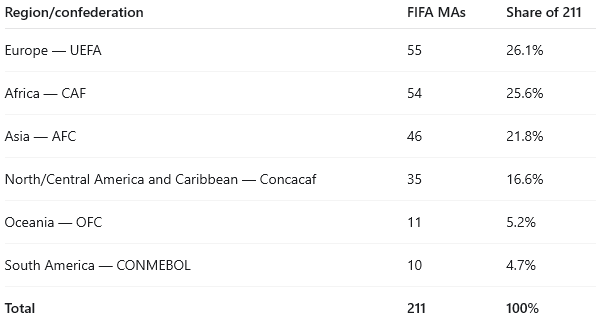
Table: # of FIFA MAs by Region/Confederation.
Source: https://inside.fifa.com/en/about-fifa/associations
What does this mean going forward? The Proposal requires a majority approval. Each MA has one vote. Therefore, FIFA requires 106 of its 211 MAs (50.24%) to approve the Proposal before it can be passed. With UEFA and Concacaf out, less than 8% of the votes are needed for this Proposal to fail.
Should other MAs follow UEFA’s path or not?
The Why
From the surface, it is hard to see why FIFA designed the Proposal.
Could it be because they are facing financial difficulties? To answer this question, I am going to look into FIFA’s main revenue source. The men’s FIFA World Cup.
FIFA commits money to tournaments, member-association distributions and development programs before much of the World Cup revenue is recognized or collected. So, it is best to run the analysis based on the FIFA reporting cycle.
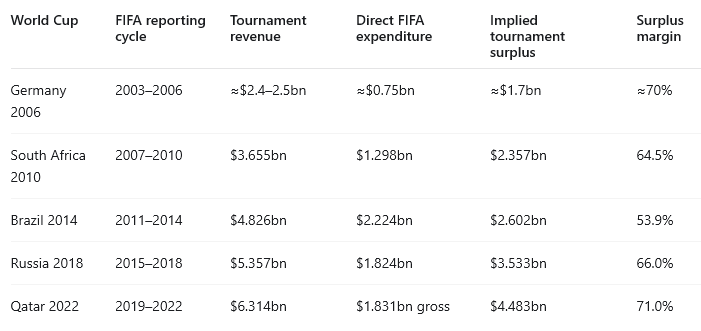
Table: Revenue and direct FIFA expenditure in the last 5 World Cups.
Figures in US$
Sources: FIFA 2019–2022 revenue and FIFA tournament expenditure
The 2026 FIFA World Cup is estimated to have generated roughly US$12 billion in revenue, almost double that from Qatar 2022. Also, assuming a surplus margin of between 54% and 71%, we can estimate a tournament surplus of US$6.5-8.5 billion, again double that of Qatar 2022 on the high end.
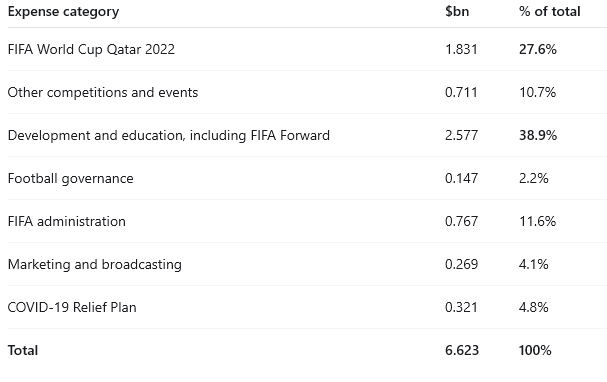
One could argue that FIFA’s direct expense is only one line item, and other expense line items could be a liquidity drag for FIFA. Looking into this, I came to realize that the donations made to MAs are actually the largest expense line item for FIFA. Take the 2019 to 2022 FIFA cycle for example, this expense represented c. 39% of total expenses.
Table: FIFA 2019 -2022 expense categorization.
Figures in US$
Source: https://publications.fifa.com/en/annual-report-2022/finances/2019-2022-cycle-in-review/2019-2022-budget-comparison/
To assess the impact on liquidity, I looked at FIFA’s net working capital (NWC). Since the World Cup takes place at the end of FIFA’s four-year reporting cycle, you might expect some liquidity pressure during the three preceding years. The numbers, however, suggest otherwise. Take the 2023–2026 cycle. FIFA’s NWC was as high as US$3.1 billion in 2024 and remained positive at US$543 million in 2025. The decline in 2025 largely reflects substantial advance payments recorded as deferred revenue ahead of the 2026 World Cup. As that revenue is recognized in 2026, FIFA’s reported NWC should improve considerably, subject to the timing of the related tournament expenditure. So, there is clearly no liquidity issue, at least one that requires private equity to address.
Or could it just be that this is the next area of focus for private equity (PE), especially US private equity? Especially how, over the last seven (7) years, private equity has slowly been allowed to acquire minority and non-controlling stakes in individual franchises within the five (5) major US sport leagues.
Table: The years in which PE investors were granted ownership in the top US sport leagues.

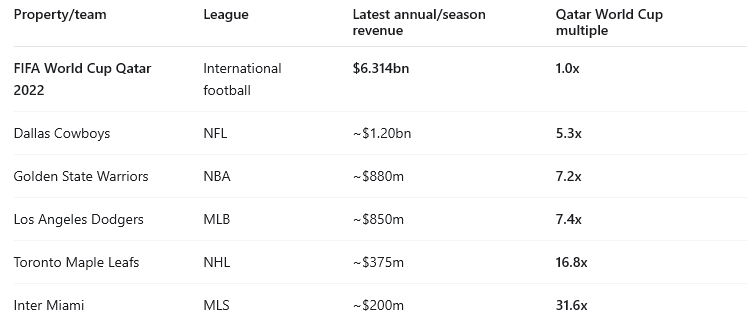
Can we look at FIFA the same way? With FIFA as the league, and the men’s FIFA World Cup as the franchise? If we can, I can understand the interest. The men’s FIFA World Cup is profitable and has revenues higher than the highest-revenue team in each major US league, even when its revenue is divided by four to account for the fact that the revenue from the other teams are annual.
Table: Qatar World Cup Revenue vs. the Highest-Revenue Team in Each Major US League
Sources: Dallas Cowboys, Golden State Warriors, MLB teams, Toronto Maple Leafs and Inter Miami.
I am sure this is not the first time private investors have tried to get a stake in FIFA tournaments, at least informally. It could just be that FIFA is beginning to crack under the pressure.
I am clearly missing something here; I am open to reading your thoughts.