

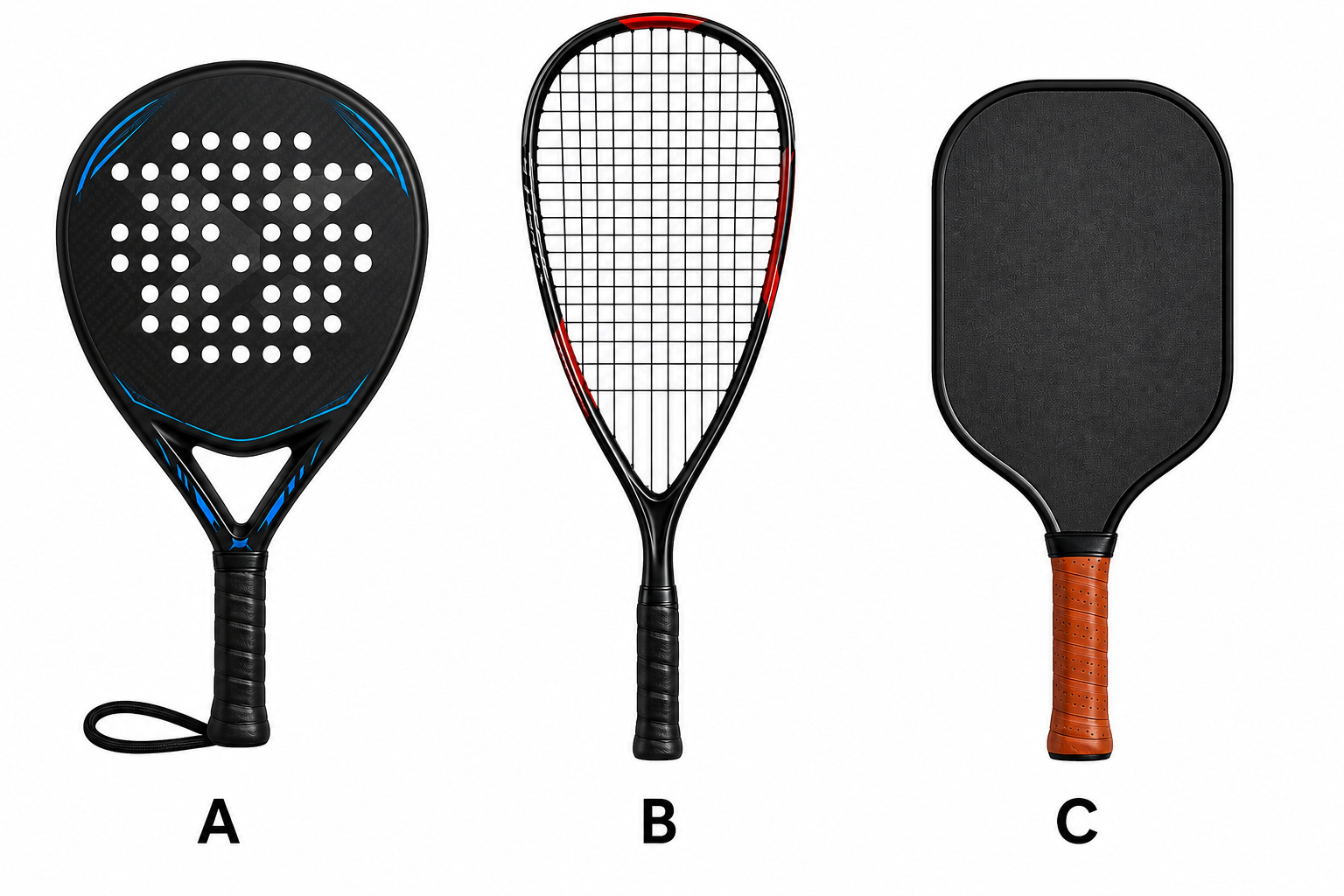
Quick question: which racket below would you say belongs to padel? Racket A, B or C? Hint: it’s not Racket B.
If you’re anything like me and live in North America, it probably feels like padel appeared out of nowhere. One day hardly anyone was talking about it, and the next it seemed to be everywhere. Today, private equity firms, real estate developers, equipment manufacturers and sports stars are all racing to claim a piece of the opportunity. But as we all know, trends don’t become global phenomena overnight.
So I decided to peek behind the curtain and understand how padel went from a niche pastime to one of the fastest-growing sports in the world.
This is a love story…kind of
If tennis and squash met at a bar, fell in love, got married, and had a child, that child would probably be called padel.
The sport was invented in Mexico in 1969 by Enrique Corcuera, who wanted to capture the essence of tennis in a smaller, enclosed space. But inventing a sport and making it popular are two very different things. That changed when Prince Alfonso of Hohenlohe, who we would probably call a super-connector today, visited his friend Enrique in Mexico and fell in love with the game. When he returned to Spain in 1974, he built what is widely considered the first official padel court at the renowned Marbella Club. This is when the dominoes began to fall.
The Marbella Club attracted celebrities, business leaders and royalty from around the world. Many tried padel during their stay, became hooked, and returned home as unofficial ambassadors for the sport. Court by court and country by country, padel’s popularity spread.
Then came the tipping point: the COVID-19 pandemic. While many indoor sports were forced to shut down, padel’s outdoor format allowed people to stay active while complying with public health restrictions. Clubs were able to reopen sooner than many gyms, and millions of people looking for a safe, social way to exercise discovered the game. What had been a steadily growing sport suddenly became a global phenomenon.
Since the pandemic, people have been craving connection
The COVID-19 pandemic changed the way many of us think about human connection. Zoom happy hours and virtual game nights were a clever substitute, but they never quite matched the experience of being in the same room as friends and family.
As the world reopened, people didn’t just want to get back to normal. They wanted to reconnect. And few things bring people together quite like sport. The challenge is that many sports come with a steep learning curve. If you didn’t grow up playing tennis, or squash, or basketball, picking them up as an adult can feel intimidating. Padel is different. The rules are simple, rallies last longer, and beginners can enjoy themselves from their very first game. It’s competitive enough to keep experienced players engaged, but accessible enough that almost anyone can step onto a court and have fun.
That combination has proven incredibly powerful. Since 2020, the number of padel players worldwide has increased nearly fourfold by 2025, according to Playtomic’s 2026 Global Padel Report.
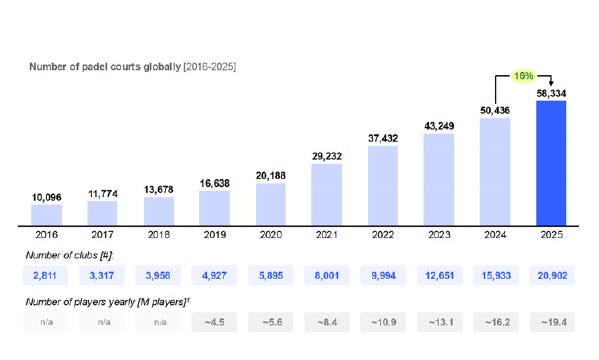
Source: Playtomic 2026 Global Padel Report
Padel is played on an enclosed court surrounded by glass and mesh walls, with the walls remaining in play after the ball bounces. The objective is to hit the ball in a way that prevents your opponents from making a legal return. Because it’s almost always played in doubles, every match is also a social experience.
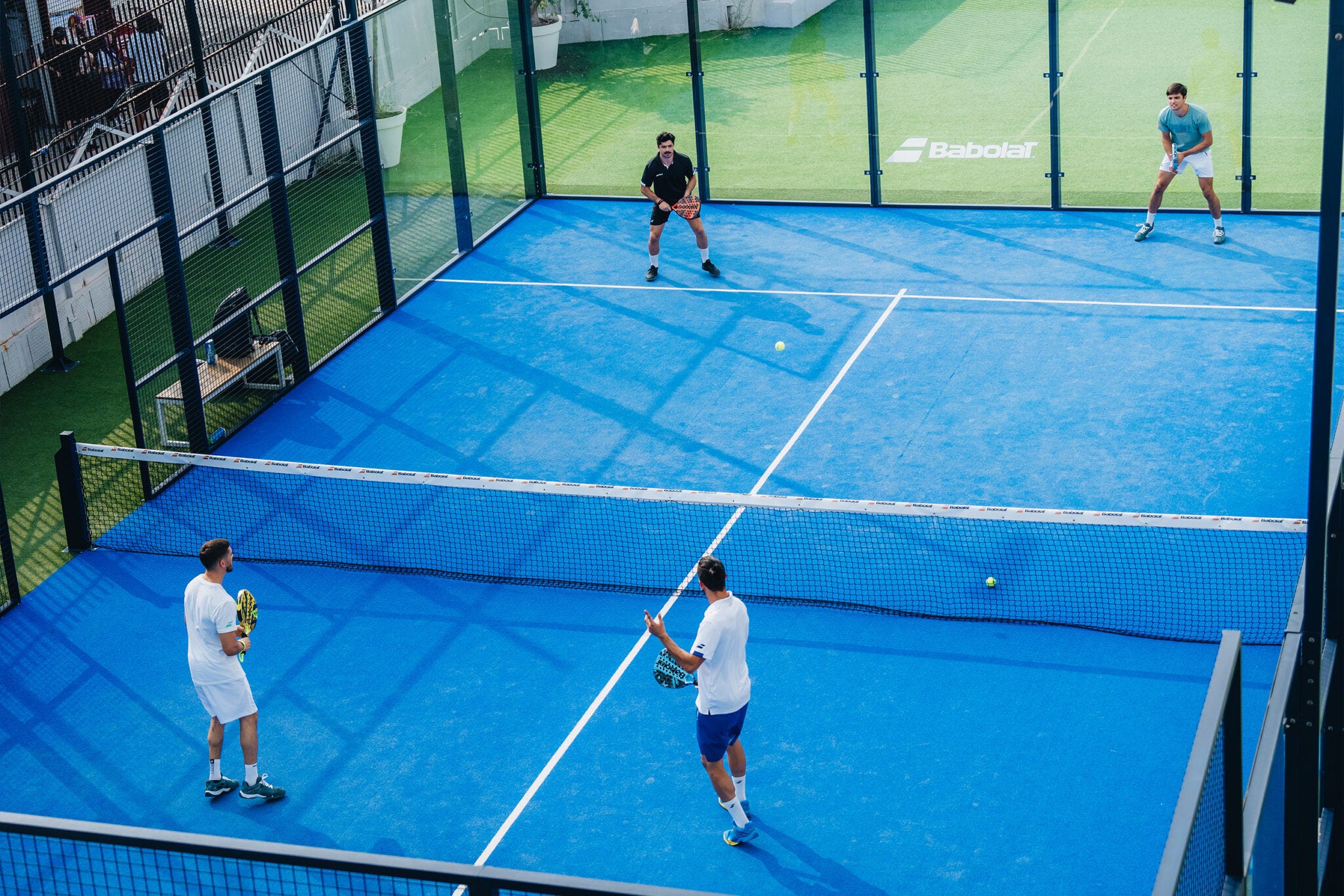
Photo credit: Swiss Padel
What makes it different from pickleball?
I will be honest, this was the biggest question I had. After digging into it, I realized there isn’t a single definitive answer. For most recreational players, the choice is surprisingly practical. People tend to play whichever sport is easiest to access, whichever their friends are playing, and whichever has courts nearby.
Geography also plays a big role. Across much of Europe, padel courts are everywhere, making padel the natural choice. In North America, it’s the opposite. Pickleball has a much larger footprint, so it is often the more accessible option.
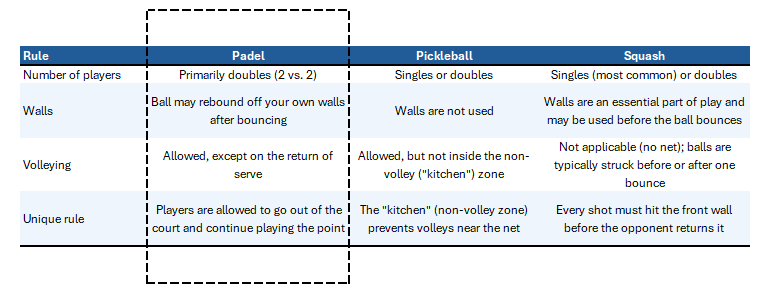
Of course, the sports are different in meaningful ways. Padel is played on an enclosed court where the walls are part of the game, creating longer rallies and a more tactical style of play. Pickleball, meanwhile, is played on an open court with its own unique rules and strategy. The table below highlights some of the key differences between the two sports.
Growth mainly in Europe
I introduced the comparison with pickleball because I think the growth stories of the two sports are closely connected. Padel is growing rapidly, but most of that growth is happening outside North America. One reason is the unit economics. Many clubs can convert an existing tennis court into several pickleball courts with relatively little investment. Padel, on the other hand, requires purpose-built courts with glass walls and steel mesh, making the upfront capital investment much higher. The other reason is that pickleball originated in North America, the United States specifically, and it is also having its moment. The result is that pickleball has spread much faster across North America, while padel has established a much stronger foothold in Europe and Latin America.
It’s also worth remembering that not every country is at the same stage of padel’s growth journey. Spain and Argentina are the most mature markets. Courts are already widespread, so the focus has shifted from simply building new facilities to increasing utilization, improving the player experience, and capturing a greater share of consumer spending. Other countries are still in the infrastructure phase. France is perhaps the best example. According to Playtomic, France accounted for the largest share of new padel courts built in 2025, a strong signal that demand is outpacing supply. It also helps that the country has thousands of ageing tennis facilities that can be redeveloped into padel clubs, making the economics of expansion particularly attractive. North America sits much earlier on the adoption curve. Court availability remains limited, and awareness is still developing. But that could change. As racket sports continue to gain popularity, the success of pickleball may end up creating a broader audience for padel, lowering the barriers to adoption and paving the way for its next phase of growth.
Monetization remains key
Padel’s future will depend on converting enthusiasm into habit. It will require affordable access, active communities, digital coordination and operators capable of matching supply with real local demand. If the industry can broaden participation without sacrificing club economics, padel can develop from a fast-growing leisure trend into a durable global sport. I will be watching closely.