

Joshua Kushner and former Disney CEO Bob Iger's ownership group recently agreed to acquire a control stake in the Los Angeles Lakers, valuing the franchise at a record-breaking $12.5 billion (pending regulatory approvals). The deal got me thinking about what this new benchmark could mean for valuations across the rest of the league.
For illiquid, homogeneous assets like shares in NBA teams, you would expect recent transactions to set the new valuation benchmark that prospective and existing investors reference… with published deal values becoming negotiating anchors for new investors (and new deals), and current owners using them to mark their holdings to market.
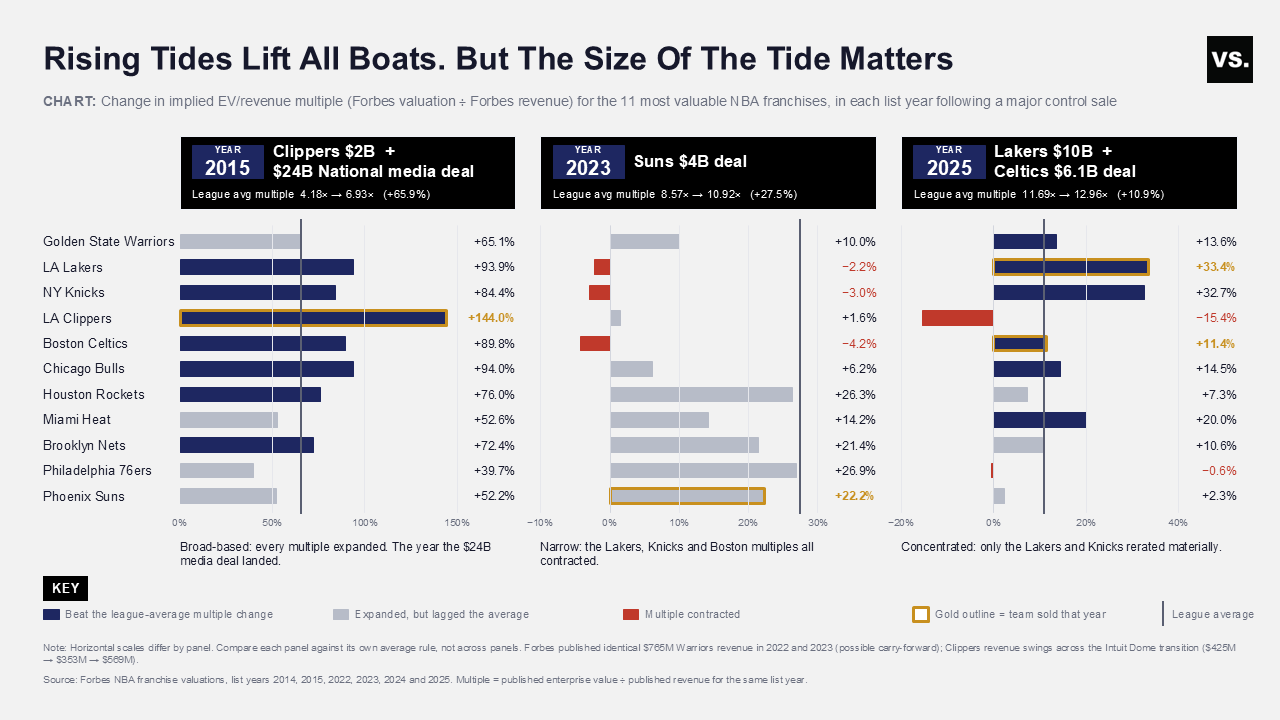
But does one transaction really reprice the entire league? I examined three record deals to explore the question.
𝐀 𝐟𝐞𝐰 𝐨𝐛𝐬𝐞𝐫𝐯𝐚𝐭𝐢𝐨𝐧𝐬 𝐞𝐦𝐞𝐫𝐠𝐞𝐝:
A record transaction involving one of the NBA’s five most valuable teams tends to have a stronger ripple effect on valuations across the league.
A record transaction involving a team outside the top five tends to have a significant effect primarily within that team’s peer group…with the teams in the peer group most likely to have a more significant valuation markup.
With only three historical data points, these findings are not statistically significant. They do, however, offer useful directional context.
There is also an important confounding factor. The Clippers’ 2014 sale coincided with the announcement of a massive national media-rights agreement. The subsequent rise in NBA franchise valuations therefore cannot be attributed solely to the Clippers transaction.
The Lakers’ $12.5 billion deal similarly comes as the league enters the second year of its new $77 billion media-rights agreement. If history is any guide, the combination could set the stage for a major league-wide repricing in 2027.
I would love to read any perspectives you have in the comments.